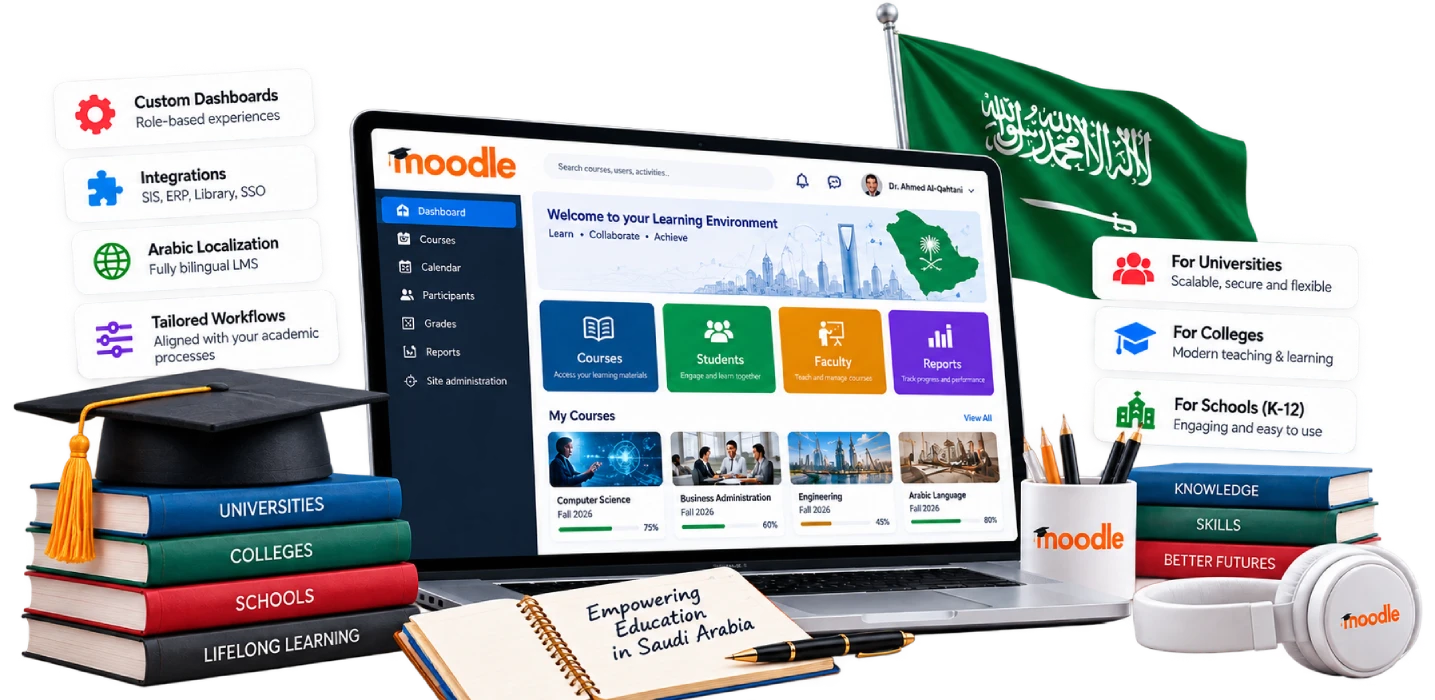
LMS setup, Arabic localization, enterprise integrations and ongoing support for Saudi universities, colleges, schools and training providers.
From campus-wide LMS infrastructure to specialized enterprise training portals, we configure, localize, and integrate Moodle around your institutional workflows and compliance mandates.
StandardTouch is a Moodle implementation and customization company in Saudi Arabia that universities, colleges, schools and training providers can work with for LMS setup, Arabic localization, integrations, migration and ongoing technical support.
We build around the institution you already have. That can mean Microsoft Entra ID for student authentication, Microsoft 365 and Teams for teaching, an SIS or ERP for enrolments, Turnitin for academic integrity, or regulatory integration requirements connected with NeLC and TVTC.
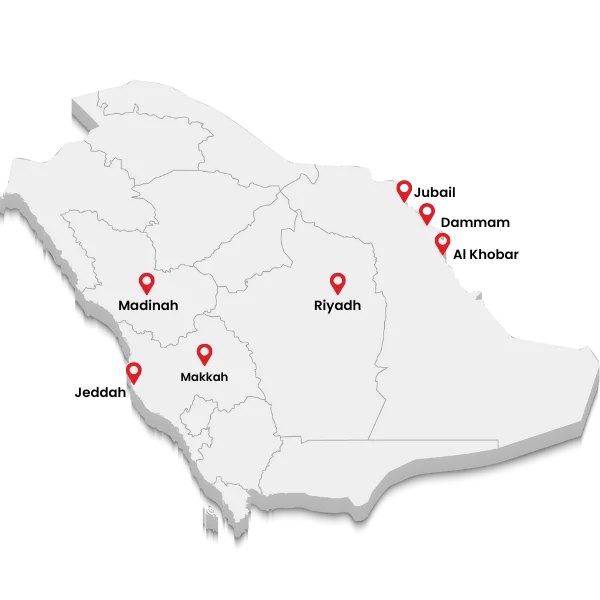
StandardTouch has 18+ years of digital delivery experience, 750+ clients, and Saudi offices in Riyadh, Jeddah, Al Khobar and Al Jubail. Selected clients include Qobolak, Jossor.com, Israr Holding and ShaheenGroup.org.
Moodle implementation in Saudi Arabia is the configuration, integration, localization and operational preparation of Moodle for a Saudi educational or training institution under its identity, data and e-learning requirements.
Fixed Implementations: Projects start from SAR 10,000
Custom Engineering: Hourly development at USD 25 / hour
A Moodle implementation in Saudi Arabia should start with the institution’s users, academic calendar, identity system and regulatory obligations, not with a list of plugins.
We configure roles, course structures, categories, enrolment rules, assessments, notifications, certificates, reporting and bilingual interfaces. Arabic RTL is tested as an operating interface rather than added at the end as a translation exercise.
For institutions offering regulated e-learning, NeLC matters early. Its LMS policy covers educational and training institutions as well as LMS solution providers and operators, and requires alignment with applicable licensing and technical standards.
A common mistake is customizing Moodle core because a workflow looks unusual. We argue against that approach where a supported plugin, theme or API can solve the same requirement. Core modifications make later upgrades harder and can turn a routine Moodle release into a redevelopment project.
Moodle customization in Saudi Arabia should reflect how faculty, students, registrars and administrators actually work.
For a university or college, that may mean faculty dashboards, course templates, faculty and department structures, assessment workflows, attendance rules, grade reporting and SIS-linked enrolment.
For a school group, the implementation may connect student rosters, teacher accounts, Microsoft School Data Sync, Google Workspace or existing school information software. Moodle’s Microsoft 365 integration supports capabilities such as Entra ID account synchronization, Teams course relationships, Outlook calendars and School Data Sync.
We also configure Arabic-first screens, RTL themes and bilingual English/Arabic navigation where required.
Moodle LMS development in Saudi Arabia can include migration and upgrade work where an institution needs to move an existing learning environment without carrying unnecessary technical debt into the new platform.
We assess the existing Moodle version, plugins, themes, authentication, course backups, user records and custom code before migration.
For a move from another LMS, we map what can be migrated programmatically and what needs structured import, rebuilding or validation.
Academic-calendar timing matters. Universities and schools usually have harder cutover windows around registration, examinations and semester starts, while corporate academies can often release in phases.
Our limitation is simple: we won’t promise that every legacy plugin or custom module can be carried forward unchanged before it has been reviewed.
Moodle becomes more useful when it exchanges the right data with the institution’s existing education software.
| Integration | What we can build | Institutional outcome |
|---|---|---|
Microsoft Entra ID, 365 and Teams | SSO, account sync, course and Teams connections, calendar and roster workflows | Centralized user access, simpler account management and smoother collaboration between Moodle and Microsoft 365 |
Google Workspace and Drive | OAuth authentication and controlled access to Google Drive content | Easier access to learning resources using existing Google accounts and familiar collaboration tools |
Turnitin | Academic integrity checks inside supported Moodle activities, subject to Turnitin licensing | A more streamlined plagiarism-checking and academic integrity workflow for assignments and assessments |
University SIS / ERP | Course, student, programme and enrolment exchange through available APIs or scheduled feeds | Reduced duplicate data entry and more consistent student, course and enrolment information across systems |
School information system | Class, teacher and student synchronization based on the school’s available interface | More efficient roster management and consistent class, teacher and student information between systems |
LTI 1.3 tools | External learning resources, authentication and grade return where supported | Easier access to third-party learning tools from Moodle with supported authentication and grade exchange |
Power BI | Management reporting using approved Moodle data flows | Clearer dashboards and reporting for academic, administrative and management teams |
FutureX / TVTC workflows | Integration planning around current institutional requirements and authorized endpoints | Better technical readiness for applicable FutureX and TVTC workflows, subject to available specifications and authorized access |
Saudi private training providers need to consider TVTC and NeLC integration requirements together when their programmes fall within the applicable e-learning framework.
In March 2026, NeLC announced that private-sector training providers would obtain programme licensing through TVTC after completing technical integration requirements with NeLC systems through FutureX, with the framework taking effect from May 2026.
That makes integration readiness a real project requirement. It doesn’t mean every Moodle site can be connected by installing a public plugin.
“We would argue against any vendor promising ‘TVTC integration’ before those details are known.”
• Scope Discovery: Integration parameters must reflect approved institutional channels.
• Endpoint Verification: Connecting only to authorized NeLC FutureX and TVTC endpoints.
• No Generic Shortcuts: Rejecting unverified public plugins that fail compliance audits.
Moodle support should keep the platform upgradeable instead of accumulating plugin and code dependencies until upgrades become risky.
Support can include version updates, security patching, plugin review, issue diagnosis, backups, performance checks and controlled release management.
For an institution running examinations or high-traffic registration periods, we can plan maintenance around academic deadlines, AST operating hours, Sunday-to-Thursday working patterns and Ramadan schedules.
Moodle implementation for Saudi commercial training providers, corporate academies, and institutes under TVTC regulatory requirements.
Projects can include competency structures, recurring compliance courses, certification rules, SCORM or xAPI content, and manager reporting.
Integrations with HR or ERP systems where suitable interfaces exist to streamline employee onboarding, role-based assignments, and corporate performance tracking.
For TVTC-regulated private training, the FutureX and licensing pathway should be checked during discovery rather than after the LMS has been configured. NeLC's current e-learning standards also place emphasis on platform interoperability, service continuity and integration with supporting educational systems.
StandardTouch supports Moodle implementation and customization projects across Saudi Arabia through offices in Riyadh, Jeddah, Al Khobar and Al Jubail, plus remote delivery and scheduled on-site visits elsewhere in the Kingdom.
Executive institutional delivery, university deployments, and central government training workflows.
Commercial academies, private colleges, and regional training institutes.
Higher education institutions, corporate academies, and international school networks.
Technical training centers, corporate industrial workforce LMS, and TVTC-aligned private providers.
We also deliver nationally for institutions in Madinah, Tabuk, Abha, Buraydah and other Saudi cities without implying that StandardTouch operates physical branches there.
Areas We Serve: Riyadh • Jeddah • Al Khobar • Al Jubail • Dammam • Dhahran • Across Saudi Arabia
Moodle implementation projects typically start from SAR 10,000. Customization work is USD 25 per hour.
Scope-Driven Pricing Without City Premiums: Final scope moves with the number of users and roles, migration complexity, bilingual requirements, custom workflows, integrations and hosting or security requirements. An institution using Microsoft Entra ID, an SIS and FutureX-related workflows will require different engineering work from a private school launching a standalone Moodle portal. We price the work around that scope rather than adding a city premium.
StandardTouch provides custom software, enterprise application, API integration and application deployment services for organisations in Saudi Arabia, with a presence in Riyadh and other Saudi locations.
As an established Moodle implementation and customization company in Saudi Arabia, that broader software background matters because a Moodle platform rarely exists on its own. We look at the learning environment, user experience, course structure, workflows, integrations and support requirements together.
If a simpler approach solves the problem, we’d rather identify that before implementation than fill the Moodle platform with features nobody uses. The same applies when Moodle isn’t the right technical choice. That should become clear during discovery, not halfway through the implementation.
"*" indicates required fields
The difference between a basic installation and an institution-specific Saudi implementation is the amount of institutional configuration, integration and local operational planning involved.
| Project Area | Basic Moodle Installation | Institution-Specific Saudi Implementation |
|---|---|---|
| Authentication | Local Moodle accounts | ✓ Entra ID, Google or institutional SSO where available |
| Enrolment | Manual or CSV | ✓ SIS, roster or API-driven workflows |
| Arabic | Language pack | ✓ Tested Arabic RTL interface and bilingual workflows |
| Academic tools | Standard activities | ✓ Turnitin, Teams, LTI and approved education systems |
| Compliance planning | Default configuration | ✓ NeLC, PDPL and applicable NCA requirements reviewed |
| Upgrades | Plugin changes as required | ✓ Upgrade-safe architecture and controlled release process |
| Reporting | Moodle reports | ✓ Role-specific reporting and optional Power BI data flows |
StandardTouch provides Moodle implementation, customization, integration, migration and ongoing technical support for educational and training institutions across Saudi Arabia.
Projects are scoped around the institution’s users, academic processes, existing systems, Arabic and English requirements, integrations, hosting considerations and applicable regulatory requirements.
If you’re planning a new Moodle deployment, migration or institution-specific customization, the first step is to define the current environment and required interfaces before deciding what needs to be configured or built.
Posted on Google![]()
Sharfuddin ShariffTrustindex verifies that the original source of the review is Google.
Posted on Google![]()
Wajhiuddin AnsariTrustindex verifies that the original source of the review is Google.
One of the best, one stop IT solution company! Most professional and motivated team.Posted on Google![]()
Hadiya NoorTrustindex verifies that the original source of the review is Google.
Posted on Google![]()
Yash ArafathTrustindex verifies that the original source of the review is Google.
Very professional... Must recommended for all online supportPosted on Google![]()
Jayapremnath MohanTrustindex verifies that the original source of the review is Google.
Excellent team!! Even post implementation also they are giving the very support!! Awesome team #StandardTouch....Posted on Google![]()
Aishwarya KulkarniTrustindex verifies that the original source of the review is Google.
Posted on Google![]()
afroz shehriyarTrustindex verifies that the original source of the review is Google.
Explore professional Moodle implementation and customization services in Saudi Arabia with StandardTouch. Serving educational institutions and businesses in Jeddah, Makkah, Madinah, Riyadh, Al Khobar, Dammam, and Jubail, our experienced team delivers tailored Moodle LMS solutions designed to streamline learning processes and support sustainable organisational growth. As a trusted Moodle implementation and customization company in Saudi Arabia (KSA), we ensure your learning platform is fully built around your users, educational requirements, and business processes to support long-term operational efficiency. Elevate your learning experience with our innovative Moodle solutions, helping your organisation achieve better learning management, improved data control, and sustainable growth across Saudi Arabia.
Detailed answers regarding Moodle implementation costs, timelines, Saudi hosting compliance, and integrations.
Moodle implementation projects in Saudi Arabia typically start from SAR 10,000, while customization is priced at USD 25 per hour. A university with SIS, Microsoft 365 and regulatory integration requirements will normally have a broader scope than a school launching one portal. Final pricing follows discovery and confirmed interfaces.
A Saudi Moodle timeline depends on migration volume, integrations, approval cycles and the academic calendar. Universities often need work scheduled around registration, examinations and semester starts, while schools or corporate training teams may have more flexible launch windows. We confirm the implementation schedule after discovery rather than publishing an invented fixed duration.
Yes. Moodle can be deployed on infrastructure selected to meet an institution’s Saudi hosting and data requirements. The correct architecture depends on the institution, data classification and applicable PDPL or NCA obligations. We can design around an approved Saudi hosting environment, but the institution remains responsible for its regulatory compliance assessment.
Yes. StandardTouch has offices in Riyadh, Jeddah, Al Khobar and Al Jubail. We serve organizations elsewhere in Saudi Arabia through remote delivery and scheduled on-site visits. We don’t describe cities outside those four locations as StandardTouch branches.
Moodle can be prepared for institution-specific TVTC and FutureX workflows where the required interfaces and permissions are available. Since May 2026, relevant private training licensing is linked to technical integration with NeLC systems through FutureX. We confirm the current specification and authorized endpoints before committing to the integration scope.
Yes. A bilingual Moodle deployment can support Arabic RTL and English interfaces, but good implementation requires more than installing a language pack. We test navigation, themes, forms, course layouts, notifications and custom components in both directions so Arabic users don’t inherit layouts designed only for left-to-right screens.
Tell us what you’re trying to build, implement, customize or improve, and which learning systems, platforms or databases are already involved. As a Moodle implementation and customization company in Saudi Arabia, we’ll use that conversation to understand the users, learning requirements, workflows and integration needs before the project is scoped.